You brought home a lavender in a 12 cm nursery pot, found a beautiful glazed container at the market, and by July the plant is grey and sulking. It happens constantly, and almost never because of the plant. On a sunny terrace, the container does more work than most people realise: it limits the roots, decides how fast the compost dries, and quietly dictates how much the whole arrangement will weigh once it has been watered twice a day. Before you choose by colour or price, walk through the checks below. They take about ten minutes and save a season of guesswork.
Start with the roots, not the rim
The most common mistake is buying a pot that looks generous with the plant still in its nursery sleeve. A container should give roots room to spread for a year or two, but not so much that wet compost sits around roots that cannot reach it.
As a working rule, choose a diameter roughly two-thirds the eventual height of the plant, and one size up from what the nursery used. Herbs and small annuals are comfortable in 20–25 cm. Bushy geraniums, compact salvias and most succulents sit well in 25–30 cm. For a rosemary that will spend years in the same pot, a lavender hedge in containers, or a small olive, start at 35–40 cm. Citrus, agapanthus, oleander and anything intended as a terrace specimen want 45 cm and upward.
Depth matters as much as width
Shallow bowls dry out fast and suit only shallow-rooted plants: sedums, portulaca, small thymes. Deep pots hold moisture longer but need more compost, which means more weight and slower drying. For a hot, exposed terrace, a slightly taller pot is usually the kinder choice, because the lower layers of compost stay cool and damp while the surface bakes.
Drainage is the whole system, not a detail
No drainage hole, no plant — with very few exceptions. One hole is a minimum; I look for three or more, or one large central hole, in containers above 30 cm. Count them in the shop, on the base, with your finger. Some pots have a hole that has been glazed over or covered by a decorative foot ring.
- Holes: several, at least a finger-width across for medium and large pots.
- Crocking: a single broken shard over the hole to stop compost washing out — not a thick layer of gravel, which raises the water table inside the pot.
- Feet: raise every pot off the floor so water can leave. Terracotta feet, small timber battens or purpose-made risers all work.
- Saucers: acceptable in summer if you empty them after rain or heavy watering. A saucer that stays full is a slow drowning.
- Flat base: a pot that rocks will crack, and a base that curves inward traps water against the hole.
If you have fallen for a hole-less pot, treat it as a cachepot: keep the plant in a plain plastic or terracotta pot inside it, and lift the inner pot out to water and drain. Never fill the gap with compost.
Read the material before you fall in love with the finish
Every material behaves differently in strong sun, and the difference shows up by August.
Terracotta
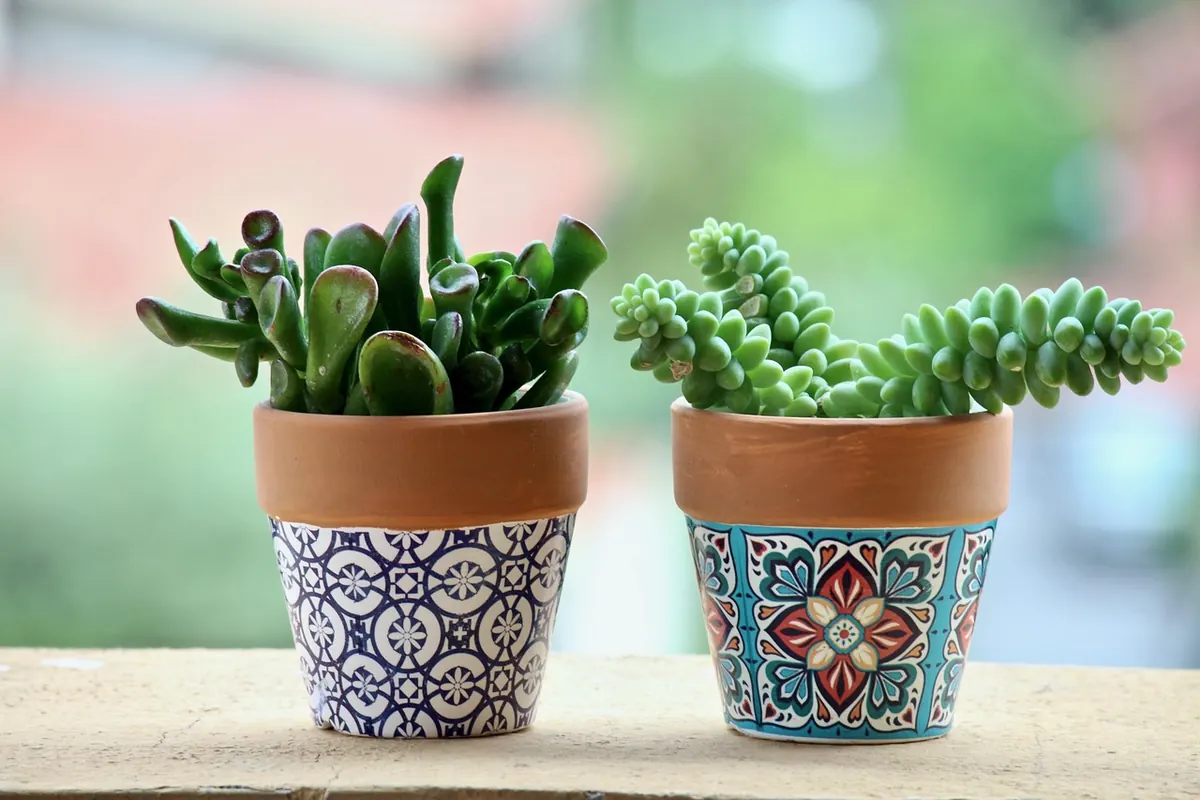
Breathes, dries quickly, looks better with age. Excellent for rosemary, lavender, thyme, succulents and anything that resents wet roots. Less good for thirsty plants, and on a windy balcony the smaller sizes tip easily. Check that it is frost-resistant if it will stay outside through winter.
Glazed ceramic
Holds moisture far longer than terracotta, so it suits citrus, ferns, hydrangeas and other plants that dislike drying out. It is heavy even when empty, and a dark glaze in full sun can get uncomfortably warm. Look for a drainage hole and an unglazed interior or a foot ring.
Plastic and resin
Light, cheap, easy to move, and available in pale colours that stay cooler. Thin plastic can overheat on the sun-facing side, so choose a lighter colour and shade the pot, not just the plant. Thick rotational-moulded plastic and fibreclay composites insulate better and last for years.
Wood, metal and concrete
Wood insulates roots well and suits large planters; line it and raise it on feet so the base does not rot. Metal heats up fast and rusts from the inside, so use it as a liner or choose powder-coated steel. Concrete is stable and cool but very heavy — a consideration for balconies and roof terraces.
Weight: the number nobody checks until the pots are full
A 45 cm pot filled with moist compost can easily pass 40 kg once the plant and a good watering are added. Multiply that by eight containers along a balcony and you are moving a small car's worth of load onto a structure that may not have been designed for it.
Weigh the empty pot before you commit, then estimate the compost — a rough guide is that a litre of moist multipurpose compost is close to a kilogram. A 40-litre bag fills a large pot once. If the terrace is on an upper floor, above a garage or on a roof, ask about load limits before delivery; a structural engineer or the building manager can tell you what is sensible, and it is far cheaper than repairing cracked paving or worse. On solid ground, weight still matters for one reason: heavy pots are almost impossible to move once planted, so decide their position first.
Sun changes the rules
On a terrace that gets six hours or more of direct summer sun, the pot itself becomes part of the microclimate. Dark containers absorb heat and can push root-zone temperatures high enough to stress shallow-rooted plants. Pale pots, light-coloured mulches and clustering containers so that foliage shades neighbouring pots all help.
Grouping also cuts watering: a tight arrangement of pots creates its own humid pocket, while a row of isolated containers in full wind dries out roughly twice as fast. Leave a gap between pots for air, but do not scatter them to the four corners if you want a manageable summer.
The two-minute check at the garden centre
- Turn the pot over and count the drainage holes.
- Measure the inner diameter at the rim, not the outer width — the difference can be several centimetres.
- Set it on a flat surface and press the rim; it should not rock.
- Tap the side. A dull thud suggests a hairline crack.
- Lift it full-height and check the rim for a comfortable grip; you will be moving it, empty or full.
- Read the label for frost resistance and UV stability if it stays outside year-round.
- Buy the saucer and the feet at the same time. You will not go back for them.
A sensible order to buy in
Measure the space first, including the height you want at eye level and the width of any walkway. Decide the plant second, because its eventual size sets the pot. Choose the material third, based on how much watering you are honestly prepared to do. Pick the colour last, once the practical questions are settled.
Then buy one size larger than feels necessary for drainage comfort, add feet and a saucer, and plant with a compost that suits the plant rather than whatever is left in the shed. If you do all that, the pots will still be doing their job in September, when the terrace is at its best and nobody wants to be repotting in the heat.
Photo: sweetlouise / Pixabay